MoreExam
1. Question Content...
EXPLANATION
Answer: X - EXPLANATION Content.
Question1: You have been tasked with creating a vSphere 6.5 data center design for an organization. The organization has provided information via requirements gathering. Evaluate each statement and determine if the requirement is functional or non-functional.Match Requirements on the left by dragging the red buttons (R1-R9) over the text of the appropriate Classification.
Question2: A company is consolidating its environment into vSphere 6.5, and uses a Fibre Channel SAN array to host a virtual machines.* It has a pair of MSCS clustered VMs with shared RDM.* High availability of service is its top priority.* It wants to ensure that performance is optimized for the cluster service.The design requirements are:* Storage should be able to withstand at least one component failure.* Each server has at least 2 ports for FC connections.* MSCS should also have no single point of failure with the clustering service.Which design will meet these requirements?A)B)C)D)
Question3: Customer Requirements:You have been tasked with creating a vSphere 6.5 data center design for an organization. The organization has provided a number of Business Continuity and Disaster Recovery (BC/DR) requirements to meet their established Service Level Agreements (SLAs). The preliminary design will include two sites.Production Site:- 6 ESXi hosts in two clusters- A Fiber Channel storage array with three types of storage:1. Flash storage2. 15K SAS drives with vFlash Read Cache3. SATA drives in RAID 5 configurationSecondary Site:- 3 ESXi hosts in a single cluster- A Fiber Channel storage array of the same type and with the same configuration as that of the production site The details of the organization's SLAs include:- Gold: Maximize read/write storage performance and provide automated offsite recovery with an RPO < 15 minutes.- Silver: Maximize read performance and provide automated offsite recovery with an RPO from 15 minutes to 24 hours.- Bronze: No performance requirement. Onsite recovery with no specific RPO.The organization has a number of web-based multi-tier applications that are governed by their SLAs. The workloads in these applications and their SLA assignments include:- Database workloads - Gold- Application workloads - Silver- Web workloads - BronzeNote that Web servers only contain static information that is site specific.Design Requirements:Create a design that incorporates the required elements:- Place an SLA container for each of the appropriate SLAs into the appropriate sites.- Place the appropriate storage type(s) for each SLA into the SLA container.- Place the appropriate workload(s) into the SLA containers.- Place the appropriate BCDR components into the SLA containers.- Connect any replicated storage between the two sites using the appropriate replication connector.
Question4: A virtualization architect has been tasked with estimating the infrastructure, licensing, and application costs for a customer's design. The customer's CEO is also interested in knowing CAPEX & OPEX, return on investment, and comparisons.Match the tool with the solution.
Question5: You have been tasked with creating a vSphere 6.5 data center design for an organization. The organization is evaluating various design options and their impact on the design. For each design option, determine the design characteristic that would be affected by utilizing the option.Match each Design Option on the left to the Characteristic on the right by dragging the red button (O1-O5) over the text of the appropriate Characteristic.NOTE: Design Options can be mapped to more than one Characteristic or none at all.
Question6: A number of factors determine how many physical adapters are needed in a host design. Which of the following is not one of them?
Question7: A customer wants to use the Microsoft NU3 clustering feature in Unicast mode in its newly-designed environment. To meet that requirement, what security policies must be configured on the network port group?
Question8: A company is designing a new vSphere cluster to support a mission-critical application.* The application requires 100% availability and cannot be restarted to recover from an ESXi host failure.* The application consists of a group of 16 virtual machines, each with 8 vCPU configured.Which solution satisfies the availability requirements?
Question9: The customer has two sites that must operate independently of each other in the event of a WAN failure.During normal operations, administrators from each site must be able to manage the other site through the vSphere Web Client.Which vCenter Server Appliance (VCSA) and Platform Services Controller (PSC) diagram shows the VMware-recommended design that satisfies these requirements?
Question10: A development team must provide layer 2 network isolation between virtual machines that are in the same VLAN. The solutions architect must provide additional security between the virtual machines on the same subnet.How can this be done without consuming more VLANs?
Question11: An architect is designing a vSphere 6.5 implementation.* The customer requires Cross vCenter vMotion for the newly-created data centers in New York and Houston.* Each data center will use different IP networks for management and vMotion.When creating a vMotion network, which two statements are required in order to use Cross vCenter Server vMotion? (Choose two.)
Question12: A company has requested assistance with a new cross-site failover design between two sites which will support business-critical applications.* Latency between the sites is less than 5ms roundtrip.* Downtime for the applications could result in millions of dollars in lost revenue.The company requires:* Application restart in the event of a total site failure* Allow for planned migration during maintenance* Applications must be kept online even when migrated due to planned site maintenance Which two options would meet the company's requirements? (Choose two.)
Question13: A company has historically used Auto Deploy without issue. They are now having issues with the PXE infrastructure.Which option can a systems architect recommend in the Auto Deploy design for better recoverability?
Question14: The system administrator team is planning to upgrade its vCenter Server 5.5 environments to version 6.5.* Each vCenter 5.5 is pointing to a Single Sign On (SSO) server that has a dedicated virtual machine.* The SSO servers are currently in independent SSO domains.* During the upgrade process, the administrators would like to combine their two SSO domains into a single one.View the exhibit.Referring to the exhibit, which upgrade scenario would accomplish this?
Question15: A solution architect has finished conducting interviews and gathering requirements for a company, and has determined that the logical requirements are:* two data centers for high availability* synchronous replication to meet the zero-minute RPO* separating management workloads from application workloads* dedicated 10Gb uplink for each low latency server* single management port for the entire environmentWhich two actions would meet the design requirements? (Choose two.)
Question16: A customer is virtualizing a mission-critical Microsoft SQL database and needs a configuration that provides optimal NUMA performance.* There are two possible clusters that the database virtual machine could reside in: Cluster A is vSphere6.0 and Cluster B is vSphere 6.5.* All ESXi hosts contain dual Intel Xeon E5-2650 v3 processors (ie: 2 socket, 10 cores per socket) and256Gb RAM with vNUMA in its default configuration.Given this scenario, which three statements are true? (Choose three.)
Question17: A customer has requested a vSphere 6.5 deployment design that utilizes vCenter Server and the use of VMware-recommended best practices for securing vCenter Server.Which three actions would satisfy these requirements? (Choose three.)
Question18: A company is consolidating its IT operations efforts by moving the Finance, IT, and QA departments towards a self-service environment, following SDDC best practices.* All departments have different priorities and expectations for uptime of the required infrastructure and applications.* Project stakeholders are still discussing final approvals for the budget wan the CFO.* To drive down the operating cost of the environment, only blade servers will implement this project.* To ensure business continuity, a colocation provider was chosen to fail over virtual machines.* The implementation of the project will follow a public reference architecture provided by VMware.What is the assumption in this scenario?
Question19: A company has requested a new vSphere 6.5 design that will allow it to finally break the 80% virtualization barrier by virtualizing its resource-intensive application.* The application is highly available by design and includes application-aware clustering software capable of operating as a fully distributed system.* The company's Application Version 2.0 consists of 386 small applications and middleware with non-persistent storage and 24 database virtual machines at each data center.* When coupled with a proper load balancing solution, this application can continue operating even with the loss of an entire data center, but the small applications and middleware tiers within a data center must exist within the same broadcast domain.* The database tier is tightly controlled with a firewall policy that only allows middleware tier access, and is replicated to other sites using a dedicated circuit.Which two application requirements apply to this scenario? (Choose two.)
Question20: After the vSAN iSCSI Target service is enabled, which statement about iSCSI networks is true?
Question21: When implementing update policies for the vSphere environment, which would be the VMware-recommended way to update the vCenter Server Appliance (VCSA) when an underlying operating system (OS) patch is released?
Question22: A company has one data center site running 50 hosts and 400 virtual machines and requires a vSphere 6.5 design.1. The CIO wants to add a secondary site for Disaster Recovery (DR) with A hours RPO.2. The application developer is concerned about anticipated growth as several new projects begin.3. The CISO is worried about data leaks and theft.4. The CTO would like to buy new servers with better specifications and higher consolidation ratio.Determine the critical requirements for each of the key stakeholders. Some requirements might have more than one stakeholder.
Question23: A customer has storage arrays from two different storage vendors at two different sites. The customer wants to restore operations at the secondary site in the event of a disaster.Which VMware technology must be used to meet this requirement?
Question24: A company has requested assistance with a new cross-site failover design between two sites which will support business-critical applications. Latency between the sites is less than 5ms round-trip.The company requires:* application must be restarted quickly in the event of a total site failure* allow for planned migration during maintenance* applications must be kept online even when migrated due to planned maintenance Drag each statement to its correct concept.
Question25: : 132A customer uses servers without internal storage and asks a systems architect to design a solution with a Fiber Channel array and blade servers as options. The customer requires:* Easier server replacement* Booting through HBA or FCoE* Less wasted space* Improved management* Batter reliability* Inexpensive servers* Easier backup processesWhich design element will follow VMware recommended best practices and also meet customer requirements?
Question26: You have been tasked with creating a vSphere 6.5 center design for an organization. The organization is currently evaluating vSphere network technologies that can be utilized with their existing infrastructure.Evaluate each statement provided through requirements gathering and determine the network technologies that can be used to meet that requirement. The technology(s) chosen should be limited to what is needed to meet, but not exceed, the given requirement.Match Statements on the left by dragging the red buttons (S1-S6) over the text of the appropriate Solution.NOTE: Statements can match more than one Solution or none at all.
Question27: A company is implementing a new cluster to support its end user desktop workloads.* The workload is required to support 200 virtual machines.* Each end-user desktop is configured with two vCPUs, 8GB of RAM, and 40GB of thick-provisioned disk space.* The architect has expressed concerns that virtual machine swap files will till the 8.5TB datastore available to the cluster.Which two strategies would address the architect's concern? (Choose two.)
Question28: A customer uses vSphere Enterprise Plus edition and wants a network administrator to monitor network traffic. Which two capabilities help with monitoring network traffic? (Choose two.)
Question29: A customer is using blade servers with only one HBA.Which two design concepts apply to this scenario? (Choose two.)
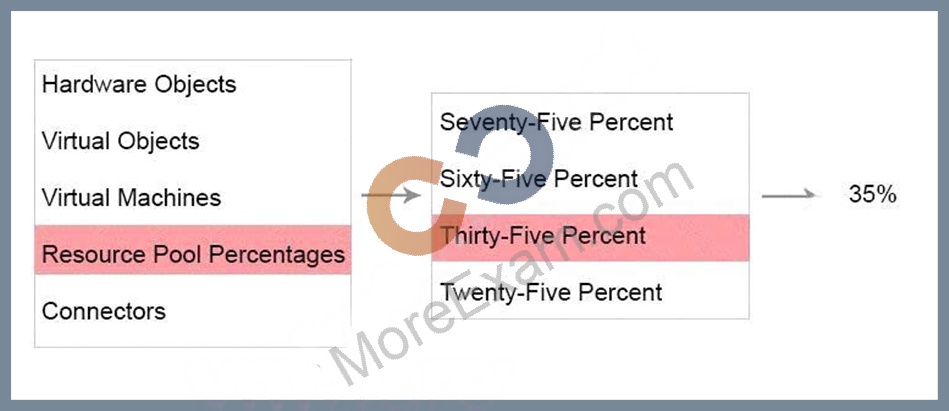
Question30: Customer Requirements:You have been tasked with creating a vSphere 6.5 data center design for an organization. The organization wants three defined virtual machine performance levels:- Gold Tier - High workload VMs- Silver Tier - Medium workload VMs- Bronze Tier - Development workload VMsThe organization has eight ESXi hosts that can be used in the design. Five of the hosts are older "medium performance" hosts, while the last 3 are newer "high performance" hosts that provide better resources when compared to the other hosts. The organization has provided a list of requirements that the design must meet:- Gold Tier virtual machines should run only on high performance servers, unless no high performance servers are available. They should also be allocated 75% of overall available resources regardless of placement.- Silver Tier virtual machines should run only on medium performance servers, unless no medium performance servers are available. They should also be allocated 25% of overall available resources regardless of placement.- Bronze Tier virtual machines should run only on medium performance servers. They should also receive a 35% subset of resources from those allocated to the Silver Tier.Design Requirements:Create a logical design that shows resource allocation and cluster policies needed to meet the customer's requirements. The design should include:- All required server(s)- All required resource(s)Place host(s) in the required DRS group(s). Place virtual machines in the appropriate resource pool(s). Connect parent to child resource pool connector(s) where needed. Connect the appropriate affinity connector(s) where needed.
Question31: A company's security team requires that its enterprise certificate authority (CA) be used to sign all SSL certificates which encrypt network traffic.Which two design implementations will accomplish this for a vCenter Server Appliance 6.5?
Question32: A company wants to deploy a new application based on containers.* The application will be hosted on a dedicated cluster in order to guarantee resources and SLAs.* Storage, networking, and compute requirements will scale linearly with the amount of users on the application.* Hardware should be minimized to reduce complexity and vendor engagement but NOT allow single points of failure.* Shift from CAPEX spending to OPEX.* Lowering TCO is a priority.Which solution fulfill all of the customer's requirements?
Question33: The web developer has stated that the site must come back online after a hardware failure without administrative intervention.What is a non-functional requirement?
Question34: A company would like to leverage snapshot technology on vSphere 6.5.Which configuration supports taking snapshots?
Question35: A system architect is building a design that includes three vCenter Server Appliances with 20 to 25 ESXi hosts each. The reliability of the environment is the top business priority because the company runs several applications that must be highly available.Which VMware solution provides the ability to centrally detect issues in the environment and resolve them?
Question36: A company is implementing a new vSphere 6.5 environment in order to virtualize one of its business-critical applications.* The existing data center equipment is over five years old and the operating system for most of the virtual machines will be end-of-life next quarter.* The database servers are physical and are also over 5 years old.* The 12 current application virtual machines are configured with two vCPUs, 16GB of memory, and60GB of* storage each.* The database administrator states that the 16 existing database servers are quad socket systems with 64 logical* processors, 256GB of memory, and a total of 230TB of storage in use.* The system administrator insists that the new virtual machines must be the same size.In this scenario, which option is a non-functional application requirement?
Question37: DRS/HA cluster services depend on which two resources? (Choose two.)
Question38: A company's CTO is very concerned about web server outages that are caused by server hardware failures.Which feature can protect the web server virtual machine from this kind of outage?
Question39: A company would like to utilize its current infrastructure but wants to adopt virtualization to consolidate its environment. Currently, the infrastructure contains:* server with 2 x 8 cores CPUs and 96G8 of memory* backup LAN with a single physical switch* production LAN* sufficient datastore performance as determined by the storage teamMatch the existing infrastructure component to its appropriate concept.
Question40: You have been tasked with creating a vSphere 6.5 data center design for an organization. During the key stakeholder and SME interviews. a set of goals, requirements, assumptions and constraints were identified.Evaluate each of the requirements, assumptions, and constraints (RAC) and determine which design characteristics apply.Match each of the Requirements, Assumptions and Constraints by dragging the RAC buttons (R1-R5) over the text of the appropriate Design Characteristic.NOTE: RACs may fit one or more of the Design Characteristics.
Question41: A company has asked a systems architect to ensure that a backup solution leverages VMware vSphere Storage APIs - Data Protections (VCAP).Which logical design concept applies to the situation?
Question42: A validation plan is used to do which of the following? (Select all that apply.)
Question43: A company is a leading provider for an online travel booking system with over a $1,000,000 turnover each day. The company warns to leverage VMware cloud solutions to consolidate, scale, and ensure high availability for all of its data centers.Match each business requirement to its appropriate design concept.
Question44: A host has three dual-port network cards. What is the maximum number of vSwitches that can be integrated with the physical network, assuming that network redundancy is not a requirement?
Question45: A university is going through an IT transformation project and is re-evaluating how to use technology to provide a better academic experience for its 15,000 students. The university is a current VMware customer and has a single data center.* Within that data center, the university is using blade servers backed by a Fibre Channel array for its business critical applications* It has two iSCSI arrays (one for the development environment and other for the no-critical production environment)* The university's VMware environment consists of three clusters. The first cluster contains all development virtual machines (VMs), the second cluster is dedicated to DMZ VMs, and the final cluster contains production VMs* The university requires the ability to perform hardware maintenance without a service interruption, and* can only sustain 4 minutes of downtime per monthFrom the list below, which three are constraints? (Choose three.)
Question46: A virtualization administrator has been tasked with migrating several business applications from physical to virtual. The administrator must also migrate the virtual machines from VMware Workstation to vSphere 6.5, using vCenter Converter Standalone 6.1.In this scenario, when two source types are supported? (Choose two.)
Question47: A customer has these requirements for storage:* Protocol used must have a file-based access.* Protocol used must have built in native multipathing.* Protocol used must support authentication.To meet these requirements, which protocol should be used for storage?
Question48: An organization is trying to determine whether it should use the Windows version of the vCenter Server or use the vCenter Server Appliance (VCSA). The organization will be using an external Oracle database, and it will manage about 30 ESXi hosts and about 200 virtual machines on 1 vCenter Server, but it would also like to see another group's vCenter Server from the same vSphere client window. Which type of vCenter Server should it use, and why?
Question49: A management company has requested that a new vSphere 6.5 design be developed to protect its existing data center investment while it expands to a second data center site and introduces process automation.* The existing environment consists of 32 vSphere 6.0 hosts attached to an iSCSI storage array containing external customer financial and medical records used by its investment and medical services divisions.* The customer is also interested in the ability to expand to and failover to a public cloud.Which two valid assumptions can be made about the new design? (Choose two.)
Question50: A company has a cluster consisting of 384GB of RAM.* Virtual machines in the production pool must run without contention of any memory resources with the other pools, while Development and QA VMs do not share this restriction.* QA VMs are considered the least important in this environment.Which resource pool design would achieve the company's requirements without introducing unnecessary contention?A)B)C)D)
Question51: A developer is tasked with building an application to process shipping requests. The developer is consulting the vSphere team to determine failover options and performance best practices.* The development team is providing three physical ESXi hosts with 8 CPU cores and 256G8 of RAM per host.* The developer does NOT know how many virtual machines they will require.Which virtual machine (VM) sizing strategy will provide the highest level of uptime, individual VM performance, and failover capacity?
Question52: A solution architect has been tasked with designing a new environment that meets the growing needs of a company, and has obtained this information:* Each new server will use a single 2-port 10Gb Converged Network Adapter (CNA) for both network and storage access.* The network team has replaced all network equipment with a 10Gb fabric.* The new environment will host both web servers and Oracle database servers.* Resources will not be overcommitted under regular upon at ions to mitigate performance issues.* The business needs a tool to understand application failures.* $1million has been budgeted for the data center expansion project.Based this information, which two statements are requirements for the new design? (Choose two.)
Question53: A customer wants to make its data available with a RPO of 10 minutes. Replication to the second data center will be done using the network.Which type of storage configuration should be used?
Question54: Customer InformationThe Customer Labtown has a new vSphere 5 environment with one of their line of business applications recently being virtulized. Labtown requires that their Webserver, Database Server, and Fileserver for their line of business app be created into a vAPP. The VM's should start up in a specific order to insure the application starts correctly after an outage or reboot. Labtown also wants the best performance possible out of each VM.There is three hosts in the cluster each running the same CPU and Memory specifications. each host is running at 60% utilization right now. Labtown doesn't have any budget for more hosts.Create a logical vAPP design for Labtowns Line of Business ApplicationRequirements- The server must boot in the following order: DB, Fileserver, WebServer- Each VM must perform the best it can with the current cluster configuration Instructions- Place the three VM's on the vAPP- Place the boot order boxes ontop of each VM to indicate the VM's boot order- Place the VM stencil for each VM in the DRS rules section if you wish to apply DRS rules to the design- As long as VM's are on the vAPP stencil marks will be scored